Here's a number that should terrify you: 63% of marketing leaders believe they drive long-term business growth. Only 35% of finance leaders agree. That's not a disagreement—that's a credibility crisis. And it's why pure creativity can't survive anymore. But pure analytics can't save you either. I watched a retailer optimise themselves into bankruptcy, obsessing over ROAS whilst remarketing to a shrinking pool of customers. The future belongs to marketers who refuse to choose between mad men and math men. Everyone else is fighting over scraps.
Insight & Analytics
Attribution
Tracking
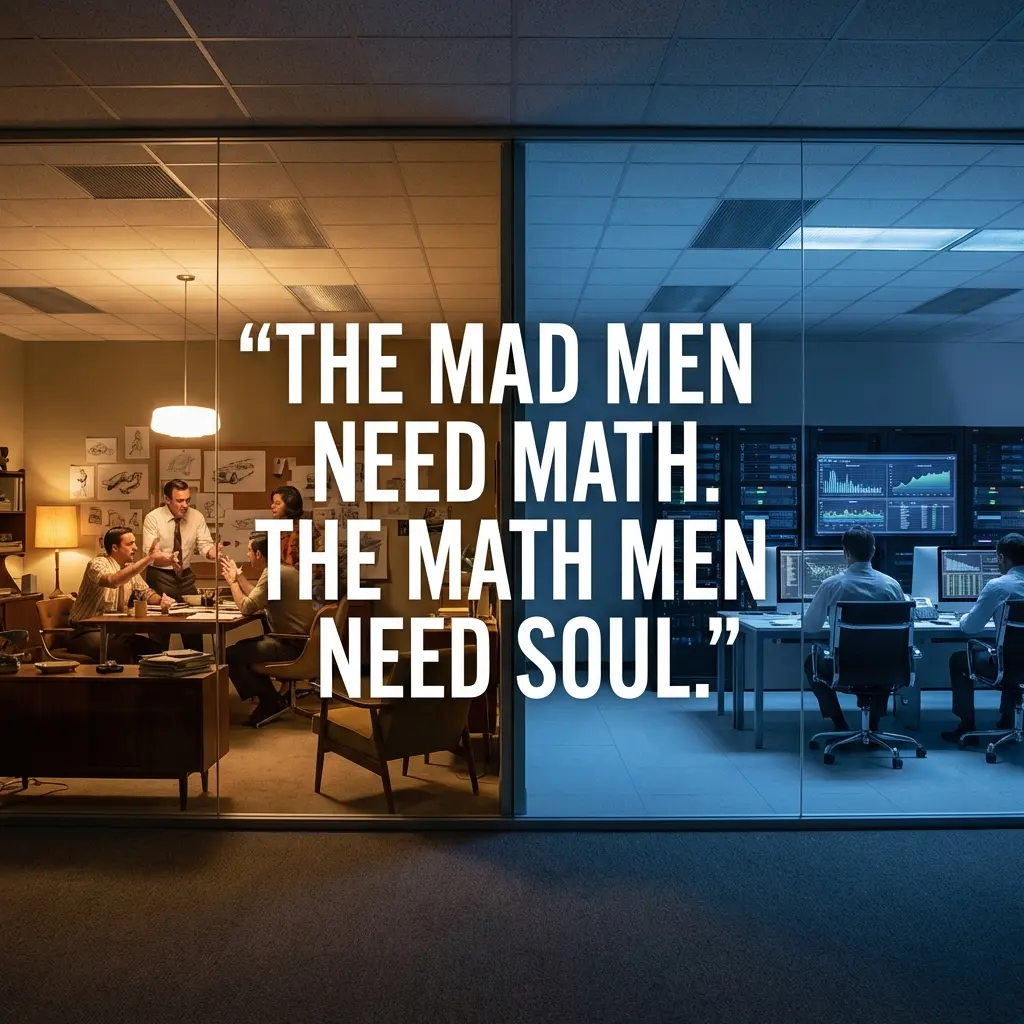
The Mad Men Need Math (And the Math Men Need Soul)
What's the gap?
This is the gap I keep seeing.
I watched a major high-street fashion retailer burn through their marketing budget last year.
They had implemented a sophisticated attribution model. They had dashboards. They had data scientists on the team.
And they were massively underinvesting in Meta because their tracking was broken.
The problem wasn't their analytics. The problem was they skipped the boring part—the part where you make sure your data collection actually works before you build fancy models on top of it.
No server-side tracking. Channel attribution wasn't capturing acquisition sources correctly. They were making million-dollar decisions based on garbage data.
Brands either have brilliant creative teams who can't prove ROI, or analytical teams who optimise campaigns nobody cares about.
The future doesn't belong to either side. It belongs to marketers who refuse to choose.
The Credibility Crisis: When Finance Doesn't Believe Your Numbers
The Credibility Crisis: When Finance Doesn't Believe Your Numbers
That's not a small disagreement. That's a credibility crisis.
Here's a number that should worry you: 63% of marketing leaders believe they drive long-term business growth.
Only 35% of finance leaders agree.
That's not a small disagreement. That's a credibility crisis.
And it explains why pure creativity can't survive anymore. You can't justify spend when half the C-suite doesn't believe your work matters.
But here's the other side: Pure analytics can't save you either.
I worked with a smaller fashion retailer who was obsessed with ROAS in each paid media channel. They leaned hard into Google Performance Max because the numbers looked good.
What they didn't realise was that Pmax was just remarketing to the same shrinking pool of existing customers and prior visitors.
As that pool shrank, ROAS dropped. Revenues fell. Their reaction? Discount harder to spike the numbers back up.
They were removing profit from the business whilst patting themselves on the back for being data-driven.
The fix wasn't more optimisation. The fix was opening up top-of-funnel activity with YouTube, Meta, and new-customer targeting campaigns. We needed people browsing before we could get them to buy.
Data without strategy is just expensive reporting.
The Expensive Mistake Both Sides Are Making
The Expensive Mistake Both Sides Are Making
"Great creativity isn't magic. It's informed by data. And great data work isn't about removing humanity from marketing—it's about proving which human connections actually work."
Creative teams think data kills the magic. They see analytics as the enemy of intuition.
Analytical teams think creativity is unmeasurable. They see brand work as a vanity project.
Both perspectives are expensive mistakes.
The reality is that noteworthy creative work is nearly always predicated on research and observation. Great creativity isn't magic. It's informed by data.
And great data work isn't about removing humanity from marketing. It's about proving which human connections actually work.
Here's what I mean in practice:
Meta's recent Andromeda update puts a much larger focus on having multiple creative treatments that appeal to specific target audiences. You need creative that's crafted to drive an emotional reaction whilst staying on-brand.
But you also need to analyse daily and weekly performance of that creative. You need to know when to double down on a treatment that's working or quickly switch to another approach that's driving engagement further down the funnel.
The creative work and the analytical work aren't separate. They're the same job.
The Skill Gap That's Creating an Opportunity
The Skill Gap That's Creating an Opportunity
"The marketers who can bridge both sides become invaluable. They can pitch a campaign that makes people feel something AND show the CFO exactly how it impacts the bottom line."
Marketing professionals who know how to calculate ROI are 1.6 times more likely to get higher budgets than others.
But only 21% of marketing leaders say they succeed at measuring their marketing ROI.
That gap represents the opportunity.
The marketers who can bridge both sides become invaluable. They can pitch a campaign that makes people feel something AND show the CFO exactly how it impacts the bottom line.
This isn't optional anymore.
Whilst 49% of marketers say they balance data and creativity, only 26% lean towards creativity. Senior leaders are much more likely to favour data-driven decisions.
If you can't speak both languages, you're fighting for budget with one hand tied behind your back.
How One Brand Beat Black Friday Without Burning Budget
How One Brand Beat Black Friday Without Burning Budget
I worked with a premium men's retailer who told me they pause all ads during Black Friday.
They couldn't afford to compete with the big brands. Their marketing budget was limited. Historically, they just turned everything off in November.
Here's what we did instead:
Six to eight weeks before November, we invested in cheaper top-of-funnel activity. We focused on CTR and engagement, not immediate conversions. We tracked email sign-ups and add-to-cart behaviours to indicate intent.
We were building an audience.
Then during Black Friday itself, we switched entirely into prospect remarketing and CRM. We weren't competing for cold traffic against brands with 10x our budget. We were talking to people who already knew us.
The creative work was about grabbing attention and building recognition early. The analytical work was about identifying who was actually interested and when to push for conversion.
Neither side works without the other.
Latest Updates
Latest Updates

Your Attribution Model Is Lying to You (And Your Data Foundation Is Why)
Jan 25, 2026
Insight & Analytics
Your Attribution Model Is Lying to You (And Your Data Foundation Is Why)
Jan 25, 2026
Insight & Analytics

Latest Updates in Plytix PIM: New Features to Help You Manage Your eCommerce Catalog Faster
Sep 9, 2025
Platforms
Latest Updates in Plytix PIM: New Features to Help You Manage Your eCommerce Catalog Faster
Sep 9, 2025
Platforms
Here's a number that should terrify you: 63% of marketing leaders believe they drive long-term business growth. Only 35% of finance leaders agree. That's not a disagreement—that's a credibility crisis. And it's why pure creativity can't survive anymore. But pure analytics can't save you either. I watched a retailer optimise themselves into bankruptcy, obsessing over ROAS whilst remarketing to a shrinking pool of customers. The future belongs to marketers who refuse to choose between mad men and math men. Everyone else is fighting over scraps.
Insight & Analytics
Attribution
Tracking
The Mad Men Need Math (And the Math Men Need Soul)
What's the gap?
This is the gap I keep seeing.
I watched a major high-street fashion retailer burn through their marketing budget last year.
They had implemented a sophisticated attribution model. They had dashboards. They had data scientists on the team.
And they were massively underinvesting in Meta because their tracking was broken.
The problem wasn't their analytics. The problem was they skipped the boring part—the part where you make sure your data collection actually works before you build fancy models on top of it.
No server-side tracking. Channel attribution wasn't capturing acquisition sources correctly. They were making million-dollar decisions based on garbage data.
Brands either have brilliant creative teams who can't prove ROI, or analytical teams who optimise campaigns nobody cares about.
The future doesn't belong to either side. It belongs to marketers who refuse to choose.
The Credibility Crisis: When Finance Doesn't Believe Your Numbers
That's not a small disagreement. That's a credibility crisis.
Here's a number that should worry you: 63% of marketing leaders believe they drive long-term business growth.
Only 35% of finance leaders agree.
That's not a small disagreement. That's a credibility crisis.
And it explains why pure creativity can't survive anymore. You can't justify spend when half the C-suite doesn't believe your work matters.
But here's the other side: Pure analytics can't save you either.
I worked with a smaller fashion retailer who was obsessed with ROAS in each paid media channel. They leaned hard into Google Performance Max because the numbers looked good.
What they didn't realise was that Pmax was just remarketing to the same shrinking pool of existing customers and prior visitors.
As that pool shrank, ROAS dropped. Revenues fell. Their reaction? Discount harder to spike the numbers back up.
They were removing profit from the business whilst patting themselves on the back for being data-driven.
The fix wasn't more optimisation. The fix was opening up top-of-funnel activity with YouTube, Meta, and new-customer targeting campaigns. We needed people browsing before we could get them to buy.
Data without strategy is just expensive reporting.
The Expensive Mistake Both Sides Are Making
"Great creativity isn't magic. It's informed by data. And great data work isn't about removing humanity from marketing—it's about proving which human connections actually work."
Creative teams think data kills the magic. They see analytics as the enemy of intuition.
Analytical teams think creativity is unmeasurable. They see brand work as a vanity project.
Both perspectives are expensive mistakes.
The reality is that noteworthy creative work is nearly always predicated on research and observation. Great creativity isn't magic. It's informed by data.
And great data work isn't about removing humanity from marketing. It's about proving which human connections actually work.
Here's what I mean in practice:
Meta's recent Andromeda update puts a much larger focus on having multiple creative treatments that appeal to specific target audiences. You need creative that's crafted to drive an emotional reaction whilst staying on-brand.
But you also need to analyse daily and weekly performance of that creative. You need to know when to double down on a treatment that's working or quickly switch to another approach that's driving engagement further down the funnel.
The creative work and the analytical work aren't separate. They're the same job.
The Skill Gap That's Creating an Opportunity
"The marketers who can bridge both sides become invaluable. They can pitch a campaign that makes people feel something AND show the CFO exactly how it impacts the bottom line."
Marketing professionals who know how to calculate ROI are 1.6 times more likely to get higher budgets than others.
But only 21% of marketing leaders say they succeed at measuring their marketing ROI.
That gap represents the opportunity.
The marketers who can bridge both sides become invaluable. They can pitch a campaign that makes people feel something AND show the CFO exactly how it impacts the bottom line.
This isn't optional anymore.
Whilst 49% of marketers say they balance data and creativity, only 26% lean towards creativity. Senior leaders are much more likely to favour data-driven decisions.
If you can't speak both languages, you're fighting for budget with one hand tied behind your back.
How One Brand Beat Black Friday Without Burning Budget
I worked with a premium men's retailer who told me they pause all ads during Black Friday.
They couldn't afford to compete with the big brands. Their marketing budget was limited. Historically, they just turned everything off in November.
Here's what we did instead:
Six to eight weeks before November, we invested in cheaper top-of-funnel activity. We focused on CTR and engagement, not immediate conversions. We tracked email sign-ups and add-to-cart behaviours to indicate intent.
We were building an audience.
Then during Black Friday itself, we switched entirely into prospect remarketing and CRM. We weren't competing for cold traffic against brands with 10x our budget. We were talking to people who already knew us.
The creative work was about grabbing attention and building recognition early. The analytical work was about identifying who was actually interested and when to push for conversion.
Neither side works without the other.
Here's a number that should terrify you: 63% of marketing leaders believe they drive long-term business growth. Only 35% of finance leaders agree. That's not a disagreement—that's a credibility crisis. And it's why pure creativity can't survive anymore. But pure analytics can't save you either. I watched a retailer optimise themselves into bankruptcy, obsessing over ROAS whilst remarketing to a shrinking pool of customers. The future belongs to marketers who refuse to choose between mad men and math men. Everyone else is fighting over scraps.
Insight & Analytics
Attribution
Tracking
The Mad Men Need Math (And the Math Men Need Soul)
What's the gap?
This is the gap I keep seeing.
I watched a major high-street fashion retailer burn through their marketing budget last year.
They had implemented a sophisticated attribution model. They had dashboards. They had data scientists on the team.
And they were massively underinvesting in Meta because their tracking was broken.
The problem wasn't their analytics. The problem was they skipped the boring part—the part where you make sure your data collection actually works before you build fancy models on top of it.
No server-side tracking. Channel attribution wasn't capturing acquisition sources correctly. They were making million-dollar decisions based on garbage data.
Brands either have brilliant creative teams who can't prove ROI, or analytical teams who optimise campaigns nobody cares about.
The future doesn't belong to either side. It belongs to marketers who refuse to choose.
The Credibility Crisis: When Finance Doesn't Believe Your Numbers
That's not a small disagreement. That's a credibility crisis.
Here's a number that should worry you: 63% of marketing leaders believe they drive long-term business growth.
Only 35% of finance leaders agree.
That's not a small disagreement. That's a credibility crisis.
And it explains why pure creativity can't survive anymore. You can't justify spend when half the C-suite doesn't believe your work matters.
But here's the other side: Pure analytics can't save you either.
I worked with a smaller fashion retailer who was obsessed with ROAS in each paid media channel. They leaned hard into Google Performance Max because the numbers looked good.
What they didn't realise was that Pmax was just remarketing to the same shrinking pool of existing customers and prior visitors.
As that pool shrank, ROAS dropped. Revenues fell. Their reaction? Discount harder to spike the numbers back up.
They were removing profit from the business whilst patting themselves on the back for being data-driven.
The fix wasn't more optimisation. The fix was opening up top-of-funnel activity with YouTube, Meta, and new-customer targeting campaigns. We needed people browsing before we could get them to buy.
Data without strategy is just expensive reporting.
The Expensive Mistake Both Sides Are Making
"Great creativity isn't magic. It's informed by data. And great data work isn't about removing humanity from marketing—it's about proving which human connections actually work."
Creative teams think data kills the magic. They see analytics as the enemy of intuition.
Analytical teams think creativity is unmeasurable. They see brand work as a vanity project.
Both perspectives are expensive mistakes.
The reality is that noteworthy creative work is nearly always predicated on research and observation. Great creativity isn't magic. It's informed by data.
And great data work isn't about removing humanity from marketing. It's about proving which human connections actually work.
Here's what I mean in practice:
Meta's recent Andromeda update puts a much larger focus on having multiple creative treatments that appeal to specific target audiences. You need creative that's crafted to drive an emotional reaction whilst staying on-brand.
But you also need to analyse daily and weekly performance of that creative. You need to know when to double down on a treatment that's working or quickly switch to another approach that's driving engagement further down the funnel.
The creative work and the analytical work aren't separate. They're the same job.
The Skill Gap That's Creating an Opportunity
"The marketers who can bridge both sides become invaluable. They can pitch a campaign that makes people feel something AND show the CFO exactly how it impacts the bottom line."
Marketing professionals who know how to calculate ROI are 1.6 times more likely to get higher budgets than others.
But only 21% of marketing leaders say they succeed at measuring their marketing ROI.
That gap represents the opportunity.
The marketers who can bridge both sides become invaluable. They can pitch a campaign that makes people feel something AND show the CFO exactly how it impacts the bottom line.
This isn't optional anymore.
Whilst 49% of marketers say they balance data and creativity, only 26% lean towards creativity. Senior leaders are much more likely to favour data-driven decisions.
If you can't speak both languages, you're fighting for budget with one hand tied behind your back.
How One Brand Beat Black Friday Without Burning Budget
I worked with a premium men's retailer who told me they pause all ads during Black Friday.
They couldn't afford to compete with the big brands. Their marketing budget was limited. Historically, they just turned everything off in November.
Here's what we did instead:
Six to eight weeks before November, we invested in cheaper top-of-funnel activity. We focused on CTR and engagement, not immediate conversions. We tracked email sign-ups and add-to-cart behaviours to indicate intent.
We were building an audience.
Then during Black Friday itself, we switched entirely into prospect remarketing and CRM. We weren't competing for cold traffic against brands with 10x our budget. We were talking to people who already knew us.
The creative work was about grabbing attention and building recognition early. The analytical work was about identifying who was actually interested and when to push for conversion.
Neither side works without the other.