Danone just spent approximately £1bn acquiring Huel.
Why Danone Paid £1bn for What It Couldn't Build: The Digital Competency Crisis Inside Legacy Retail
2026
Danone just spent approximately £1bn acquiring Huel.
Most coverage frames this as market consolidation in functional nutrition. Smart move, growing category, all the usual analysis.
But when you've sat on retail boards making acquisition decisions, you see something different. You see a £150m+ corporation admitting it cannot build what a 2015 startup executed naturally.
The acquisition price tells you everything. Huel projects £250m revenue for 2025 with a 10% EBITDA margin. That's a 4x revenue multiple. In a market where mature food and beverage businesses trade at far lower multiples, Danone paid a premium that defies conventional valuation logic.
They're not buying market share. They're buying operational DNA they cannot replicate internally.
What Danone Actually Purchased
Danone's CEO Antoine de Saint-Affrique stated publicly that Huel has "best in class digital capabilities" and they look forward to "learning from one another."
That phrasing matters. "Learning from" is corporate code for "we don't possess this expertise ourselves."
Danone has dominated supermarket aisles for decades. They understand mass market distribution, global supply chains, and retail relationships at scale. What they've never managed is maximising margins through direct-to-consumer operations.
They're acquiring the cultural mentality of focusing on new customer acquisition, subscription modelling, and promotional mechanisms that drive lifetime value versus in-store sell-through.
That's not a product acquisition. That's an education purchase.
The Supply Chain Rigidity Problem
Legacy FMCG brands operate with a fundamental principle problem. Their business model centres on volume. They conduct rigorous testing and market research, often across multiple territories, with extended timescales to develop new product ranges. This reduces risk and focuses on lower margin, mass market global scale.
Huel historically operated on startup mentality. Fail fast, scale quicker. Identify new potential routes to market, test multiple approaches, see what sticks, then scale.
The difference shows up in specific operational decisions. Many FMCG brands cannot flex their manufacturing or supply chains to create agility around pack sizes, testing new flavours, or limited editions to engage consumers.
When customer demands sit at the core of your business, you build systems that respond. When volume efficiency drives decisions, you build systems that resist change.
Danone could invest in flexible manufacturing. They could hire DTC experts. They could restructure supply chains for agility.
But here's what happens in practice.
The 12-24 Month Exodus Pattern
DTC experts get brought into FMCG brands with desire to sell direct to consumers. They often leave within 12-24 months.
The restrictions around systems, product development, logistics, and the inability to adapt and flex become insurmountable. Their classic business model centres on volume. Shareholders and boards consider the startup approach too much of a risk.
This creates an incompatibility problem. The organisational antibodies attack the foreign expertise—new approaches get filtered through existing approval processes, agile methodologies get trapped in quarterly planning cycles, and risk tolerance gets vetoed by risk committees.
We saw this with Graze. Unilever acquired the business for £150m in 2019. After sustaining ongoing losses attempting to integrate it into their wider business and standard operating model, they've now sold it to Katjes International for approximately £35m.
That's a 77% destruction of acquisition value within six years.
The pattern repeats because the structural problem remains unsolved. Matrix organisations with multiple divisions, geo-location operating units, manufacturing facilities, and centralised teams create accountability diffusion.
Even if someone spends 12 months in Huel and returns enlightened, they walk into a system designed to diffuse accountability. There's no single throat to choke, no clear ownership.
The Autonomy Illusion
Danone's keeping Huel's founder James McMaster in place and maintaining operational autonomy. Most analysts call this smart M&A execution.
But the founder will have been used to total autonomy. Slowly, large corporates cannot help but look to see where they can absorb the culture into their own. They impose new operating procedures around procurement, ingredient sourcing, rostered agencies that challenge the founder's entire sense of what his business set out to be.
His exit is inevitable. When is debatable.
The value extraction window runs 18-36 months before cultural dilution destroys what they bought. In that window, Danone needs to identify which executives actually understand subscription mechanics, customer acquisition playbooks, and agile product development cycles.
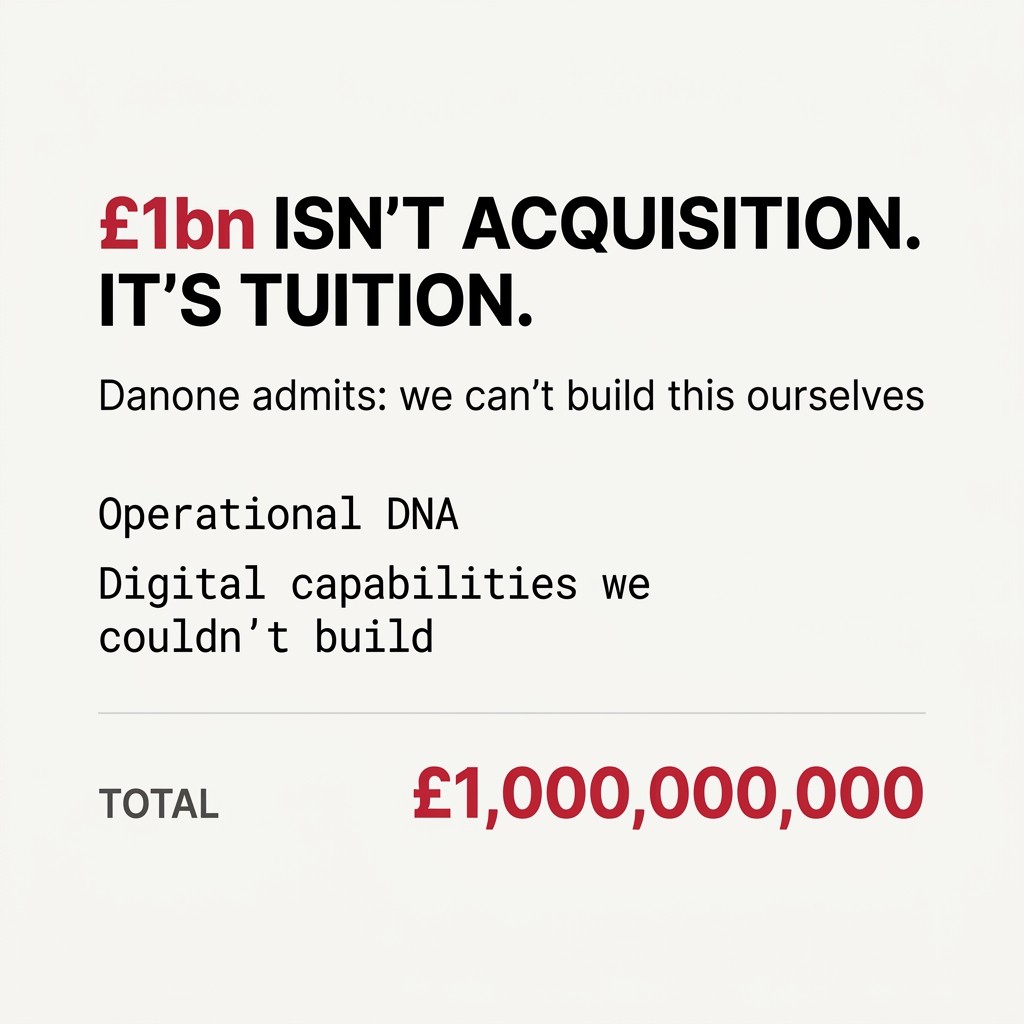
The £1bn isn't for a sustainable business unit. It's tuition fees for a masterclass in digital commerce that their own teams failed to deliver after years of trying.
The smart play would be treating it like an internal consultancy. Rotate their best operators through Huel for 6-12 month placements, document everything, then let the founder exit with dignity whilst applying those learnings to Alpro, Actimel, and other brands.
But most corporations won't do that because it requires admitting the acquisition was never about integration. It was about education.
The Political Resistance That Kills Knowledge Transfer
When you're sitting in strategy meetings and someone proposes rotating executives through for knowledge transfer, the idea sounds rational.
But here's the actual political resistance.
Danone operates as a matrix organisation. The challenge comes around two questions. Will people be given space to spend long enough in Huel to adapt to their culture? Will the group allow these new principles and mindsets to be absorbed back into their division to deliver results?
A shift in culture has to be total and all-encompassing to be effective. It has to come from the absolute top.
Innovation is not the adoption of a new system or a change in operating model. It is the shift in culture to open up time across the business. Allow teams time to think differently, challenge the normal modus operandi, and breed innovation.
Innovation is not a programme of work. It's a shift in mindset that has to be seeded, nurtured, and failures celebrated to show that change is being made and learnings create material shifts in approach and profits.
The Shareholder Reality
Shareholders have to be managed. They inherently look for return on investment, which can be challenging.
However, all shareholders understand the principle of market share gain, customer lifetime value, and operational efficiencies. Make money, save money, drive efficiency.
It takes time and strategic decision-making to position a new culture of innovation and market agility. It requires extensive education around the robustness of an approach and how, commercially, risks will be mitigated and profits managed.
But when you're a publicly traded corporation where quarterly earnings drive everything, celebrating failures becomes nearly impossible. You've still got P&L responsibility and shareholders expecting results.
This is why the acquisition approach fails. The structural incentives prevent the cultural transfer that justifies the acquisition price.
What Huel Actually Built
Huel's evolution from pure DTC subscription to omnichannel presence demonstrates strategic distribution expansion. They moved from online-only to supermarket meal deals, convenience stores, and branded vending machines in rail terminals.
The company now operates in more than 25,000 retail locations globally. Retail makes up about a third of £110m UK revenues, having more than doubled in the past year. That's a 128% expansion in retail presence.
This isn't just channel diversification. It's category innovation. Huel competes in supermarket lunch sections against sandwiches, installs branded vending in transport hubs against grab-and-go retailers, and maintains subscription services against meal kit companies.
They defined their own retail contexts rather than fitting into existing categories.
The referral programme drives growth with approximately 22% of customers referring friends. 60% of these referrals convert into new customers, resulting in 12% year-over-year increase in referral revenue.
After reducing marketing expenses from 41% of revenue in 2021 to 35% in 2022, Huel achieved higher efficiency. Their Marketing Efficiency Ratio improved from 2.44 to 2.87.
That's the operational DNA Danone cannot replicate. Not because they lack resources, but because their systems prevent this type of execution.
What Mid-Market Retailers Should Learn
The Danone-Huel acquisition exposes a structural truth about retail's evolution.
Legacy corporations with massive resources cannot build digital-native customer relationships internally. The systems, incentives, and cultural patterns prevent execution.
When a £150m+ business admits this publicly by spending £1bn on acquisition, it validates what mid-market retailers already suspect. The gap between traditional retail operations and digital commerce isn't about budget. It's about operational DNA.
Huel's valuation journey from $560m in 2022 to approximately £1bn in 2026 represents an 80% increase during a period when many tech and consumer brands contracted. This illustrates the premium placed on profitable, growing businesses with clear product-market fit.
The company pivoted from exploring an IPO in 2021 to accepting acquisition, demonstrating strategic flexibility in capitalising on market conditions.
But the fundamental lesson transcends industry specifics.
Businesses that solve genuine consumer pain points whilst building defensible operational advantages create acquisition value that significantly exceeds financial metrics alone.
Huel's journey from niche subscription service to £1bn acquisition target exemplifies how focused execution on clear value propositions, combined with channel innovation and operational maturity, creates strategic assets that incumbents will pay premiums to acquire rather than compete against.
The question for scaling retailers becomes clear.
Are you building operational capabilities that legacy corporations cannot replicate? Or are you competing in categories where they can simply outspend you?
Because when Danone pays £1bn for what they couldn't build themselves, they're not just buying a business. They're admitting a capability gap that no amount of internal investment has closed.
That admission creates opportunity for everyone watching from the sidelines.

Danone just spent approximately £1bn acquiring Huel.
Why Danone Paid £1bn for What It Couldn't Build: The Digital Competency Crisis Inside Legacy Retail
2026
Danone just spent approximately £1bn acquiring Huel.
Most coverage frames this as market consolidation in functional nutrition. Smart move, growing category, all the usual analysis.
But when you've sat on retail boards making acquisition decisions, you see something different. You see a £150m+ corporation admitting it cannot build what a 2015 startup executed naturally.
The acquisition price tells you everything. Huel projects £250m revenue for 2025 with a 10% EBITDA margin. That's a 4x revenue multiple. In a market where mature food and beverage businesses trade at far lower multiples, Danone paid a premium that defies conventional valuation logic.
They're not buying market share. They're buying operational DNA they cannot replicate internally.
What Danone Actually Purchased
Danone's CEO Antoine de Saint-Affrique stated publicly that Huel has "best in class digital capabilities" and they look forward to "learning from one another."
That phrasing matters. "Learning from" is corporate code for "we don't possess this expertise ourselves."
Danone has dominated supermarket aisles for decades. They understand mass market distribution, global supply chains, and retail relationships at scale. What they've never managed is maximising margins through direct-to-consumer operations.
They're acquiring the cultural mentality of focusing on new customer acquisition, subscription modelling, and promotional mechanisms that drive lifetime value versus in-store sell-through.
That's not a product acquisition. That's an education purchase.
The Supply Chain Rigidity Problem
Legacy FMCG brands operate with a fundamental principle problem. Their business model centres on volume. They conduct rigorous testing and market research, often across multiple territories, with extended timescales to develop new product ranges. This reduces risk and focuses on lower margin, mass market global scale.
Huel historically operated on startup mentality. Fail fast, scale quicker. Identify new potential routes to market, test multiple approaches, see what sticks, then scale.
The difference shows up in specific operational decisions. Many FMCG brands cannot flex their manufacturing or supply chains to create agility around pack sizes, testing new flavours, or limited editions to engage consumers.
When customer demands sit at the core of your business, you build systems that respond. When volume efficiency drives decisions, you build systems that resist change.
Danone could invest in flexible manufacturing. They could hire DTC experts. They could restructure supply chains for agility.
But here's what happens in practice.
The 12-24 Month Exodus Pattern
DTC experts get brought into FMCG brands with desire to sell direct to consumers. They often leave within 12-24 months.
The restrictions around systems, product development, logistics, and the inability to adapt and flex become insurmountable. Their classic business model centres on volume. Shareholders and boards consider the startup approach too much of a risk.
This creates an incompatibility problem. The organisational antibodies attack the foreign expertise—new approaches get filtered through existing approval processes, agile methodologies get trapped in quarterly planning cycles, and risk tolerance gets vetoed by risk committees.
We saw this with Graze. Unilever acquired the business for £150m in 2019. After sustaining ongoing losses attempting to integrate it into their wider business and standard operating model, they've now sold it to Katjes International for approximately £35m.
That's a 77% destruction of acquisition value within six years.
The pattern repeats because the structural problem remains unsolved. Matrix organisations with multiple divisions, geo-location operating units, manufacturing facilities, and centralised teams create accountability diffusion.
Even if someone spends 12 months in Huel and returns enlightened, they walk into a system designed to diffuse accountability. There's no single throat to choke, no clear ownership.
The Autonomy Illusion
Danone's keeping Huel's founder James McMaster in place and maintaining operational autonomy. Most analysts call this smart M&A execution.
But the founder will have been used to total autonomy. Slowly, large corporates cannot help but look to see where they can absorb the culture into their own. They impose new operating procedures around procurement, ingredient sourcing, rostered agencies that challenge the founder's entire sense of what his business set out to be.
His exit is inevitable. When is debatable.
The value extraction window runs 18-36 months before cultural dilution destroys what they bought. In that window, Danone needs to identify which executives actually understand subscription mechanics, customer acquisition playbooks, and agile product development cycles.
The £1bn isn't for a sustainable business unit. It's tuition fees for a masterclass in digital commerce that their own teams failed to deliver after years of trying.
The smart play would be treating it like an internal consultancy. Rotate their best operators through Huel for 6-12 month placements, document everything, then let the founder exit with dignity whilst applying those learnings to Alpro, Actimel, and other brands.
But most corporations won't do that because it requires admitting the acquisition was never about integration. It was about education.
The Political Resistance That Kills Knowledge Transfer
When you're sitting in strategy meetings and someone proposes rotating executives through for knowledge transfer, the idea sounds rational.
But here's the actual political resistance.
Danone operates as a matrix organisation. The challenge comes around two questions. Will people be given space to spend long enough in Huel to adapt to their culture? Will the group allow these new principles and mindsets to be absorbed back into their division to deliver results?
A shift in culture has to be total and all-encompassing to be effective. It has to come from the absolute top.
Innovation is not the adoption of a new system or a change in operating model. It is the shift in culture to open up time across the business. Allow teams time to think differently, challenge the normal modus operandi, and breed innovation.
Innovation is not a programme of work. It's a shift in mindset that has to be seeded, nurtured, and failures celebrated to show that change is being made and learnings create material shifts in approach and profits.
The Shareholder Reality
Shareholders have to be managed. They inherently look for return on investment, which can be challenging.
However, all shareholders understand the principle of market share gain, customer lifetime value, and operational efficiencies. Make money, save money, drive efficiency.
It takes time and strategic decision-making to position a new culture of innovation and market agility. It requires extensive education around the robustness of an approach and how, commercially, risks will be mitigated and profits managed.
But when you're a publicly traded corporation where quarterly earnings drive everything, celebrating failures becomes nearly impossible. You've still got P&L responsibility and shareholders expecting results.
This is why the acquisition approach fails. The structural incentives prevent the cultural transfer that justifies the acquisition price.
What Huel Actually Built
Huel's evolution from pure DTC subscription to omnichannel presence demonstrates strategic distribution expansion. They moved from online-only to supermarket meal deals, convenience stores, and branded vending machines in rail terminals.
The company now operates in more than 25,000 retail locations globally. Retail makes up about a third of £110m UK revenues, having more than doubled in the past year. That's a 128% expansion in retail presence.
This isn't just channel diversification. It's category innovation. Huel competes in supermarket lunch sections against sandwiches, installs branded vending in transport hubs against grab-and-go retailers, and maintains subscription services against meal kit companies.
They defined their own retail contexts rather than fitting into existing categories.
The referral programme drives growth with approximately 22% of customers referring friends. 60% of these referrals convert into new customers, resulting in 12% year-over-year increase in referral revenue.
After reducing marketing expenses from 41% of revenue in 2021 to 35% in 2022, Huel achieved higher efficiency. Their Marketing Efficiency Ratio improved from 2.44 to 2.87.
That's the operational DNA Danone cannot replicate. Not because they lack resources, but because their systems prevent this type of execution.
What Mid-Market Retailers Should Learn
The Danone-Huel acquisition exposes a structural truth about retail's evolution.
Legacy corporations with massive resources cannot build digital-native customer relationships internally. The systems, incentives, and cultural patterns prevent execution.
When a £150m+ business admits this publicly by spending £1bn on acquisition, it validates what mid-market retailers already suspect. The gap between traditional retail operations and digital commerce isn't about budget. It's about operational DNA.
Huel's valuation journey from $560m in 2022 to approximately £1bn in 2026 represents an 80% increase during a period when many tech and consumer brands contracted. This illustrates the premium placed on profitable, growing businesses with clear product-market fit.
The company pivoted from exploring an IPO in 2021 to accepting acquisition, demonstrating strategic flexibility in capitalising on market conditions.
But the fundamental lesson transcends industry specifics.
Businesses that solve genuine consumer pain points whilst building defensible operational advantages create acquisition value that significantly exceeds financial metrics alone.
Huel's journey from niche subscription service to £1bn acquisition target exemplifies how focused execution on clear value propositions, combined with channel innovation and operational maturity, creates strategic assets that incumbents will pay premiums to acquire rather than compete against.
The question for scaling retailers becomes clear.
Are you building operational capabilities that legacy corporations cannot replicate? Or are you competing in categories where they can simply outspend you?
Because when Danone pays £1bn for what they couldn't build themselves, they're not just buying a business. They're admitting a capability gap that no amount of internal investment has closed.
That admission creates opportunity for everyone watching from the sidelines.
Danone just spent approximately £1bn acquiring Huel.
Why Danone Paid £1bn for What It Couldn't Build: The Digital Competency Crisis Inside Legacy Retail
2026
Danone just spent approximately £1bn acquiring Huel.
Most coverage frames this as market consolidation in functional nutrition. Smart move, growing category, all the usual analysis.
But when you've sat on retail boards making acquisition decisions, you see something different. You see a £150m+ corporation admitting it cannot build what a 2015 startup executed naturally.
The acquisition price tells you everything. Huel projects £250m revenue for 2025 with a 10% EBITDA margin. That's a 4x revenue multiple. In a market where mature food and beverage businesses trade at far lower multiples, Danone paid a premium that defies conventional valuation logic.
They're not buying market share. They're buying operational DNA they cannot replicate internally.
What Danone Actually Purchased
Danone's CEO Antoine de Saint-Affrique stated publicly that Huel has "best in class digital capabilities" and they look forward to "learning from one another."
That phrasing matters. "Learning from" is corporate code for "we don't possess this expertise ourselves."
Danone has dominated supermarket aisles for decades. They understand mass market distribution, global supply chains, and retail relationships at scale. What they've never managed is maximising margins through direct-to-consumer operations.
They're acquiring the cultural mentality of focusing on new customer acquisition, subscription modelling, and promotional mechanisms that drive lifetime value versus in-store sell-through.
That's not a product acquisition. That's an education purchase.
The Supply Chain Rigidity Problem
Legacy FMCG brands operate with a fundamental principle problem. Their business model centres on volume. They conduct rigorous testing and market research, often across multiple territories, with extended timescales to develop new product ranges. This reduces risk and focuses on lower margin, mass market global scale.
Huel historically operated on startup mentality. Fail fast, scale quicker. Identify new potential routes to market, test multiple approaches, see what sticks, then scale.
The difference shows up in specific operational decisions. Many FMCG brands cannot flex their manufacturing or supply chains to create agility around pack sizes, testing new flavours, or limited editions to engage consumers.
When customer demands sit at the core of your business, you build systems that respond. When volume efficiency drives decisions, you build systems that resist change.
Danone could invest in flexible manufacturing. They could hire DTC experts. They could restructure supply chains for agility.
But here's what happens in practice.
The 12-24 Month Exodus Pattern
DTC experts get brought into FMCG brands with desire to sell direct to consumers. They often leave within 12-24 months.
The restrictions around systems, product development, logistics, and the inability to adapt and flex become insurmountable. Their classic business model centres on volume. Shareholders and boards consider the startup approach too much of a risk.
This creates an incompatibility problem. The organisational antibodies attack the foreign expertise—new approaches get filtered through existing approval processes, agile methodologies get trapped in quarterly planning cycles, and risk tolerance gets vetoed by risk committees.
We saw this with Graze. Unilever acquired the business for £150m in 2019. After sustaining ongoing losses attempting to integrate it into their wider business and standard operating model, they've now sold it to Katjes International for approximately £35m.
That's a 77% destruction of acquisition value within six years.
The pattern repeats because the structural problem remains unsolved. Matrix organisations with multiple divisions, geo-location operating units, manufacturing facilities, and centralised teams create accountability diffusion.
Even if someone spends 12 months in Huel and returns enlightened, they walk into a system designed to diffuse accountability. There's no single throat to choke, no clear ownership.
The Autonomy Illusion
Danone's keeping Huel's founder James McMaster in place and maintaining operational autonomy. Most analysts call this smart M&A execution.
But the founder will have been used to total autonomy. Slowly, large corporates cannot help but look to see where they can absorb the culture into their own. They impose new operating procedures around procurement, ingredient sourcing, rostered agencies that challenge the founder's entire sense of what his business set out to be.
His exit is inevitable. When is debatable.
The value extraction window runs 18-36 months before cultural dilution destroys what they bought. In that window, Danone needs to identify which executives actually understand subscription mechanics, customer acquisition playbooks, and agile product development cycles.
The £1bn isn't for a sustainable business unit. It's tuition fees for a masterclass in digital commerce that their own teams failed to deliver after years of trying.
The smart play would be treating it like an internal consultancy. Rotate their best operators through Huel for 6-12 month placements, document everything, then let the founder exit with dignity whilst applying those learnings to Alpro, Actimel, and other brands.
But most corporations won't do that because it requires admitting the acquisition was never about integration. It was about education.
The Political Resistance That Kills Knowledge Transfer
When you're sitting in strategy meetings and someone proposes rotating executives through for knowledge transfer, the idea sounds rational.
But here's the actual political resistance.
Danone operates as a matrix organisation. The challenge comes around two questions. Will people be given space to spend long enough in Huel to adapt to their culture? Will the group allow these new principles and mindsets to be absorbed back into their division to deliver results?
A shift in culture has to be total and all-encompassing to be effective. It has to come from the absolute top.
Innovation is not the adoption of a new system or a change in operating model. It is the shift in culture to open up time across the business. Allow teams time to think differently, challenge the normal modus operandi, and breed innovation.
Innovation is not a programme of work. It's a shift in mindset that has to be seeded, nurtured, and failures celebrated to show that change is being made and learnings create material shifts in approach and profits.
The Shareholder Reality
Shareholders have to be managed. They inherently look for return on investment, which can be challenging.
However, all shareholders understand the principle of market share gain, customer lifetime value, and operational efficiencies. Make money, save money, drive efficiency.
It takes time and strategic decision-making to position a new culture of innovation and market agility. It requires extensive education around the robustness of an approach and how, commercially, risks will be mitigated and profits managed.
But when you're a publicly traded corporation where quarterly earnings drive everything, celebrating failures becomes nearly impossible. You've still got P&L responsibility and shareholders expecting results.
This is why the acquisition approach fails. The structural incentives prevent the cultural transfer that justifies the acquisition price.
What Huel Actually Built
Huel's evolution from pure DTC subscription to omnichannel presence demonstrates strategic distribution expansion. They moved from online-only to supermarket meal deals, convenience stores, and branded vending machines in rail terminals.
The company now operates in more than 25,000 retail locations globally. Retail makes up about a third of £110m UK revenues, having more than doubled in the past year. That's a 128% expansion in retail presence.
This isn't just channel diversification. It's category innovation. Huel competes in supermarket lunch sections against sandwiches, installs branded vending in transport hubs against grab-and-go retailers, and maintains subscription services against meal kit companies.
They defined their own retail contexts rather than fitting into existing categories.
The referral programme drives growth with approximately 22% of customers referring friends. 60% of these referrals convert into new customers, resulting in 12% year-over-year increase in referral revenue.
After reducing marketing expenses from 41% of revenue in 2021 to 35% in 2022, Huel achieved higher efficiency. Their Marketing Efficiency Ratio improved from 2.44 to 2.87.
That's the operational DNA Danone cannot replicate. Not because they lack resources, but because their systems prevent this type of execution.
What Mid-Market Retailers Should Learn
The Danone-Huel acquisition exposes a structural truth about retail's evolution.
Legacy corporations with massive resources cannot build digital-native customer relationships internally. The systems, incentives, and cultural patterns prevent execution.
When a £150m+ business admits this publicly by spending £1bn on acquisition, it validates what mid-market retailers already suspect. The gap between traditional retail operations and digital commerce isn't about budget. It's about operational DNA.
Huel's valuation journey from $560m in 2022 to approximately £1bn in 2026 represents an 80% increase during a period when many tech and consumer brands contracted. This illustrates the premium placed on profitable, growing businesses with clear product-market fit.
The company pivoted from exploring an IPO in 2021 to accepting acquisition, demonstrating strategic flexibility in capitalising on market conditions.
But the fundamental lesson transcends industry specifics.
Businesses that solve genuine consumer pain points whilst building defensible operational advantages create acquisition value that significantly exceeds financial metrics alone.
Huel's journey from niche subscription service to £1bn acquisition target exemplifies how focused execution on clear value propositions, combined with channel innovation and operational maturity, creates strategic assets that incumbents will pay premiums to acquire rather than compete against.
The question for scaling retailers becomes clear.
Are you building operational capabilities that legacy corporations cannot replicate? Or are you competing in categories where they can simply outspend you?
Because when Danone pays £1bn for what they couldn't build themselves, they're not just buying a business. They're admitting a capability gap that no amount of internal investment has closed.
That admission creates opportunity for everyone watching from the sidelines.