You're looking at two platforms and trying to work out which one makes sense for your business.
Shopify vs WooCommerce: The Platform Decision That Actually Matters
2026
TL;DR: Shopify outperforms WooCommerce in revenue generation despite WooCommerce's larger market share. Shopify delivers 17% higher conversion rates, 36% lower total cost of ownership, and superior mobile performance (69% vs 62%). WooCommerce's "free" positioning masks hidden costs exceeding £800 annually, plus developer fees and maintenance burdens.
The Shopify WordPress Plugin offers a hybrid solution combining WordPress content management with Shopify's eCommerce infrastructure.
Shopify vs WooCommerce: Core Differences
Revenue performance: Shopify achieves 17% higher conversion rates (4.7% vs 2-3%) and generated $292 billion GMV in 2024 compared to WooCommerce's $30-35 billion.
True costs: Shopify's total cost of ownership is 36% lower than WooCommerce, which costs £800+ annually plus developer fees (£8-£120/hour).
Mobile commerce: Shopify captures 69% of mobile sales versus WooCommerce's 62%, critical as mobile traffic dominates.
Infrastructure reliability: Shopify provides 99.9% uptime and automatic updates, whilst 49% of WooCommerce stores load in over one second.
Hybrid solution: Shopify WordPress Plugin enables headless commerce—WordPress for content, Shopify for transactions.
You're looking at two platforms and trying to work out which one makes sense for your business.
WooCommerce looks free. Shopify costs money every month. The decision feels obvious.
Except it's the wrong question entirely.
I've spent thirty-five years at senior management level in retail, including four years on the board of a £150m clothing retailer. I've overseen technology infrastructure decisions that either unlocked growth or created expensive problems that took years to fix.
The platform conversation isn't about features or flexibility. It's about what actually drives revenue, what costs you money you can't see, and whether you're optimising for the right outcome.
Why Does Market Share Mislead When Choosing Between Shopify and WooCommerce?
WooCommerce powers 38.76% of all eCommerce websites globally. Shopify sits at 28.8% of the top 1 million sites.
If you stopped there, you'd pick WooCommerce.
But here's what those numbers hide: Shopify's GMV reached $292 billion in 2024 and is on pace to exceed $350 billion in 2025. WooCommerce's estimated GMV sits at $30–35 billion annually.
More stores doesn't mean more revenue.
It means WooCommerce dominates the market by store count whilst Shopify dominates by transaction volume. You're choosing between being one of millions of sites or being one of the merchants actually making money.
Bottom line: WooCommerce's 38.76% market share reflects store count, not revenue performance. Shopify's $292 billion GMV in 2024 versus WooCommerce's $30-35 billion proves transaction volume matters more than site numbers.
What's the Real Revenue Impact of Platform Choice?
Conversion rates tell you everything about platform performance.
Shopify has a 17% higher conversion rate than WooCommerce on average. The top 10% of Shopify stores achieve 4.7% conversion rates. WooCommerce stores typically sit at 2-3%.
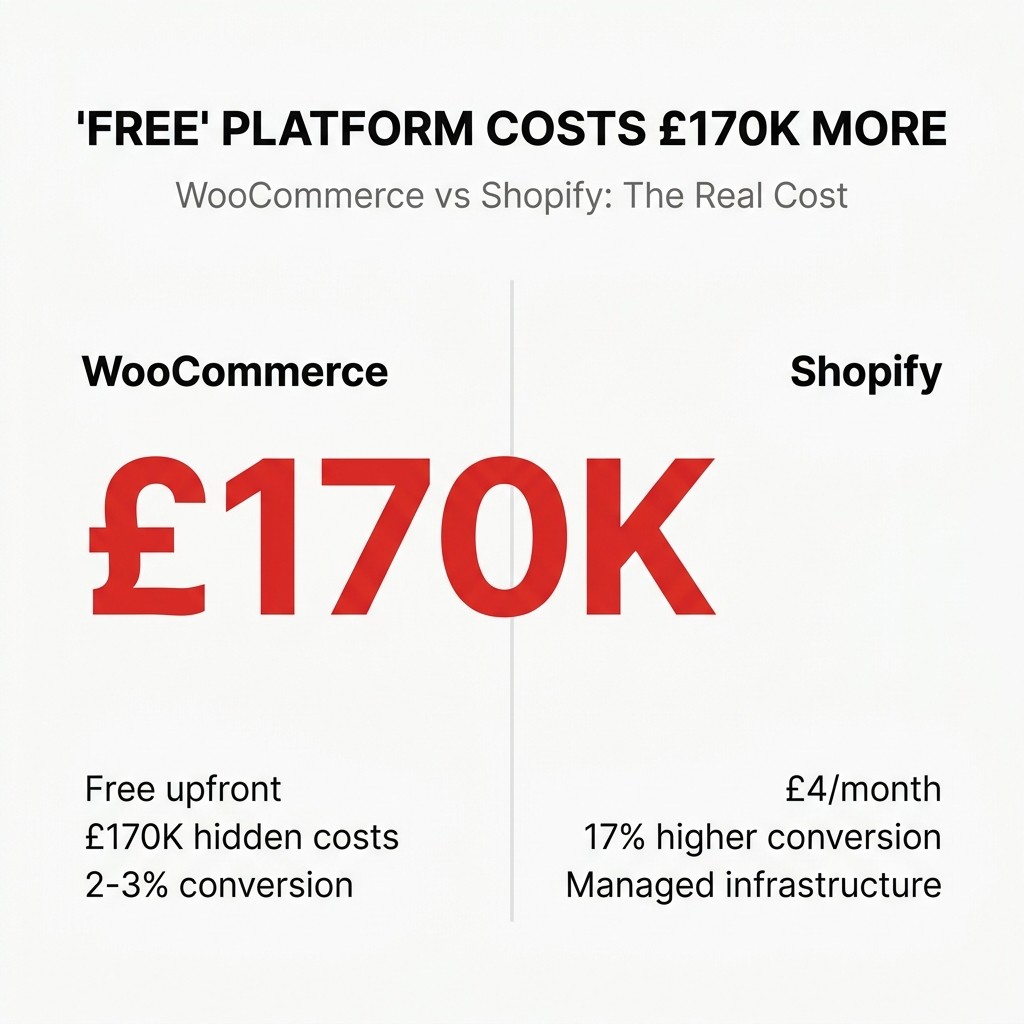
If you're running a £1 million annual revenue business, that 17% differential represents £170,000 in lost revenue every year.
That's not a rounding error. That's the cost of choosing the wrong infrastructure.
The gap gets worse on mobile. Shopify captures 69% of mobile sales. WooCommerce captures 62%. In a marketplace where mobile traffic dominates, that 7 percentage point difference compounds every single day.
The conversion gap: Shopify's 17% higher conversion rates translate to £170,000 in lost annual revenue for a £1 million business on WooCommerce. Mobile performance amplifies this—Shopify captures 69% of mobile sales versus WooCommerce's 62%.
How Much Does WooCommerce Actually Cost?
WooCommerce positions itself as free. Technically accurate. Operationally misleading.
Shopify's total cost of ownership is 36% better than WooCommerce, on average. WooCommerce's limited functionality and complex integrations lead to about 49% higher setup costs.
Fully-featured WooCommerce installations typically exceed £800 in annual operational costs, excluding developer dependencies ranging from £8 to £120 per hour, security maintenance, and the opportunity cost of your internal time.
You're not paying a subscription fee. You're paying in developer hours, plugin conflicts, security vulnerabilities, and the mental overhead of managing infrastructure that should be invisible.
Shopify starts at £4 monthly for basic WordPress integration. The cost is transparent. The infrastructure is managed. The updates happen automatically.
When you factor in what it actually costs to run a WooCommerce store properly, the "free" positioning collapses.
True cost comparison: WooCommerce's "free" software requires £800+ annually in operational costs, plus developer fees (£8-£120/hour) and security maintenance. Shopify's total cost of ownership is 36% lower because infrastructure management is included.
Which Platform Performs Better Under Traffic Load?
49% of WooCommerce stores load in over one second. That directly impacts conversion rates and user experience.
Shopify delivers 99.9% uptime through enterprise-grade hosting and built-in CDN technology. Your store stays accessible during Black Friday, Cyber Monday, and every other peak trading period when downtime destroys revenue.
The self-hosting model in WooCommerce means performance varies dramatically based on your hosting provider, your technical team's capabilities, and how well you've optimised your setup.
You're not just choosing a platform. You're choosing whether infrastructure reliability is your problem or theirs.
Infrastructure reality: 49% of WooCommerce stores load in over one second, directly harming conversions. Shopify guarantees 99.9% uptime through enterprise hosting and CDN technology, therefore eliminating performance as your operational burden.
Can You Trust Your Platform's Data and Reporting?
I've seen a £25,000 monthly revenue store struggle with unreliable WooCommerce reporting and order data. The inconsistencies forced manual reconciliation processes and created difficulties for scaling operations and accurate financial analysis.
When your reporting doesn't match reality, you can't make informed decisions. You're flying blind whilst trying to scale.
Shopify's managed infrastructure eliminates these data reliability concerns. The reporting works. The analytics are consistent. You can trust the numbers you're looking at.
Data integrity matters: WooCommerce's self-hosted architecture creates reporting inconsistencies that force manual reconciliation and prevent accurate financial analysis. Shopify's managed infrastructure delivers consistent, trustworthy analytics.
Is There a Hybrid Solution That Combines Both Platforms?
The Shopify WordPress Plugin creates a headless commerce solution that lets you manage content through WordPress whilst leveraging Shopify's eCommerce infrastructure for transactions, inventory, and order processing.
You get WordPress flexibility for content. You get Shopify performance for commerce.
This eliminates the forced choice between content management capabilities and transaction infrastructure. You're not abandoning your WordPress investment. You're augmenting it with managed commerce that actually works.
Headless commerce advantage: The Shopify WordPress Plugin enables you to manage content through WordPress whilst Shopify handles transactions, inventory, and order processing—eliminating the forced choice between platforms.
How Should You Make the Platform Decision?
Platform decisions create consequences that compound over years.
If you choose based on upfront cost, you'll spend the next three years managing technical debt, troubleshooting plugin conflicts, and wondering why your conversion rates lag behind competitors.
If you choose based on business outcomes, you'll focus on the metrics that actually matter: conversion rates, mobile performance, infrastructure reliability, and total cost of ownership.
The question isn't which platform is cheaper. The question is which platform makes you more money whilst costing you less time, fewer headaches, and lower operational overhead.
I've overseen these decisions at board level. I've seen what happens when businesses optimise for the wrong variables. The "free" option that creates expensive problems. The managed solution that unlocks growth.
Your platform isn't just technical infrastructure. It's the foundation that either enables or constrains everything you're trying to build.
Choose accordingly.
Decision framework: Choose based on business outcomes (conversion rates, mobile performance, infrastructure reliability, total cost of ownership) rather than upfront cost. Platform decisions compound over years—the wrong choice means managing technical debt instead of growing revenue.
Frequently Asked Questions
Which platform is better for beginners: Shopify or WooCommerce?
Shopify is better for beginners because it provides managed infrastructure with automatic updates, 24/7 support, and no technical maintenance required. WooCommerce requires self-hosting knowledge, plugin management, and ongoing security updates, which create operational burdens for those without technical expertise.
Why does Shopify have higher conversion rates than WooCommerce?
Shopify achieves 17% higher conversion rates because of optimised checkout processes, faster page load speeds, superior mobile performance, and enterprise-grade hosting that maintains 99.9% uptime. In contrast, 49% of WooCommerce stores load in over one second, which directly harms conversion rates.
Is WooCommerce really free to use?
WooCommerce's core plugin is free, but running a functional store costs £800+ annually in hosting, premium plugins, themes, and security. Developer fees range from £8 to £120 per hour for customisation and troubleshooting. Therefore, Shopify's total cost of ownership is 36% lower than WooCommerce when all expenses are factored in.
Can I use WordPress with Shopify?
Yes. The Shopify WordPress Plugin creates a headless commerce solution where you manage content through WordPress whilst Shopify handles all eCommerce functions—transactions, inventory, order processing, and payment security. This hybrid approach starts at £4 monthly and eliminates hosting complexities.
Which platform is better for mobile commerce?
Shopify outperforms WooCommerce in mobile commerce, capturing 69% of mobile sales versus WooCommerce's 62%. Because mobile traffic dominates eCommerce, this 7 percentage point difference compounds daily and significantly impacts revenue performance.
What happens to my data if I migrate from WooCommerce to Shopify?
Shopify provides migration tools and support to transfer products, customer data, and order history from WooCommerce. The migration requires planning around SEO preservation and URL structure, but eliminates the data reliability issues common in WooCommerce's self-hosted environment.
Does Shopify work during high-traffic events like Black Friday?
Yes. Shopify guarantees 99.9% uptime through enterprise-grade hosting and CDN technology. The platform handled £9.2 billion in Black Friday sales in 2024 without performance degradation. WooCommerce's self-hosted model means performance varies dramatically based on your hosting provider during traffic spikes.
Which platform scales better as my business grows?
Shopify scales more effectively because infrastructure management is automatic—no hosting upgrades, security patches, or plugin conflicts to manage. WooCommerce requires ongoing technical maintenance that becomes increasingly complex as transaction volume grows, often necessitating expensive developer support.
Key Takeaways
Revenue trumps market share: Shopify's $292 billion GMV versus WooCommerce's $30-35 billion proves transaction volume matters more than the number of stores using a platform.
Conversion rates drive profitability: Shopify's 17% higher conversion rates cost WooCommerce merchants £170,000 annually on a £1 million revenue business—this isn't a minor difference, it's structural underperformance.
"Free" software carries hidden costs: WooCommerce requires £800+ annually plus developer fees (£8-£120/hour), making Shopify's total cost of ownership 36% lower despite monthly subscription fees.
Mobile performance is non-negotiable: Shopify captures 69% of mobile sales versus WooCommerce's 62%, critical as mobile traffic dominates eCommerce and this gap compounds daily.
Infrastructure reliability eliminates operational burden: Shopify's 99.9% uptime and automatic updates mean you focus on growing your business, not managing servers, whilst 49% of WooCommerce stores suffer from slow load times.
Data integrity enables informed decisions: WooCommerce's reporting inconsistencies force manual reconciliation and prevent accurate financial analysis, whilst Shopify delivers trustworthy analytics that scale with your business.
Hybrid solutions exist: The Shopify WordPress Plugin combines WordPress content management with Shopify's eCommerce infrastructure, eliminating the forced choice between platforms for £4 monthly.


You're looking at two platforms and trying to work out which one makes sense for your business.
Shopify vs WooCommerce: The Platform Decision That Actually Matters
2026
TL;DR: Shopify outperforms WooCommerce in revenue generation despite WooCommerce's larger market share. Shopify delivers 17% higher conversion rates, 36% lower total cost of ownership, and superior mobile performance (69% vs 62%). WooCommerce's "free" positioning masks hidden costs exceeding £800 annually, plus developer fees and maintenance burdens.
The Shopify WordPress Plugin offers a hybrid solution combining WordPress content management with Shopify's eCommerce infrastructure.
Shopify vs WooCommerce: Core Differences
Revenue performance: Shopify achieves 17% higher conversion rates (4.7% vs 2-3%) and generated $292 billion GMV in 2024 compared to WooCommerce's $30-35 billion.
True costs: Shopify's total cost of ownership is 36% lower than WooCommerce, which costs £800+ annually plus developer fees (£8-£120/hour).
Mobile commerce: Shopify captures 69% of mobile sales versus WooCommerce's 62%, critical as mobile traffic dominates.
Infrastructure reliability: Shopify provides 99.9% uptime and automatic updates, whilst 49% of WooCommerce stores load in over one second.
Hybrid solution: Shopify WordPress Plugin enables headless commerce—WordPress for content, Shopify for transactions.
You're looking at two platforms and trying to work out which one makes sense for your business.
WooCommerce looks free. Shopify costs money every month. The decision feels obvious.
Except it's the wrong question entirely.
I've spent thirty-five years at senior management level in retail, including four years on the board of a £150m clothing retailer. I've overseen technology infrastructure decisions that either unlocked growth or created expensive problems that took years to fix.
The platform conversation isn't about features or flexibility. It's about what actually drives revenue, what costs you money you can't see, and whether you're optimising for the right outcome.
Why Does Market Share Mislead When Choosing Between Shopify and WooCommerce?
WooCommerce powers 38.76% of all eCommerce websites globally. Shopify sits at 28.8% of the top 1 million sites.
If you stopped there, you'd pick WooCommerce.
But here's what those numbers hide: Shopify's GMV reached $292 billion in 2024 and is on pace to exceed $350 billion in 2025. WooCommerce's estimated GMV sits at $30–35 billion annually.
More stores doesn't mean more revenue.
It means WooCommerce dominates the market by store count whilst Shopify dominates by transaction volume. You're choosing between being one of millions of sites or being one of the merchants actually making money.
Bottom line: WooCommerce's 38.76% market share reflects store count, not revenue performance. Shopify's $292 billion GMV in 2024 versus WooCommerce's $30-35 billion proves transaction volume matters more than site numbers.
What's the Real Revenue Impact of Platform Choice?
Conversion rates tell you everything about platform performance.
Shopify has a 17% higher conversion rate than WooCommerce on average. The top 10% of Shopify stores achieve 4.7% conversion rates. WooCommerce stores typically sit at 2-3%.
If you're running a £1 million annual revenue business, that 17% differential represents £170,000 in lost revenue every year.
That's not a rounding error. That's the cost of choosing the wrong infrastructure.
The gap gets worse on mobile. Shopify captures 69% of mobile sales. WooCommerce captures 62%. In a marketplace where mobile traffic dominates, that 7 percentage point difference compounds every single day.
The conversion gap: Shopify's 17% higher conversion rates translate to £170,000 in lost annual revenue for a £1 million business on WooCommerce. Mobile performance amplifies this—Shopify captures 69% of mobile sales versus WooCommerce's 62%.
How Much Does WooCommerce Actually Cost?
WooCommerce positions itself as free. Technically accurate. Operationally misleading.
Shopify's total cost of ownership is 36% better than WooCommerce, on average. WooCommerce's limited functionality and complex integrations lead to about 49% higher setup costs.
Fully-featured WooCommerce installations typically exceed £800 in annual operational costs, excluding developer dependencies ranging from £8 to £120 per hour, security maintenance, and the opportunity cost of your internal time.
You're not paying a subscription fee. You're paying in developer hours, plugin conflicts, security vulnerabilities, and the mental overhead of managing infrastructure that should be invisible.
Shopify starts at £4 monthly for basic WordPress integration. The cost is transparent. The infrastructure is managed. The updates happen automatically.
When you factor in what it actually costs to run a WooCommerce store properly, the "free" positioning collapses.
True cost comparison: WooCommerce's "free" software requires £800+ annually in operational costs, plus developer fees (£8-£120/hour) and security maintenance. Shopify's total cost of ownership is 36% lower because infrastructure management is included.
Which Platform Performs Better Under Traffic Load?
49% of WooCommerce stores load in over one second. That directly impacts conversion rates and user experience.
Shopify delivers 99.9% uptime through enterprise-grade hosting and built-in CDN technology. Your store stays accessible during Black Friday, Cyber Monday, and every other peak trading period when downtime destroys revenue.
The self-hosting model in WooCommerce means performance varies dramatically based on your hosting provider, your technical team's capabilities, and how well you've optimised your setup.
You're not just choosing a platform. You're choosing whether infrastructure reliability is your problem or theirs.
Infrastructure reality: 49% of WooCommerce stores load in over one second, directly harming conversions. Shopify guarantees 99.9% uptime through enterprise hosting and CDN technology, therefore eliminating performance as your operational burden.
Can You Trust Your Platform's Data and Reporting?
I've seen a £25,000 monthly revenue store struggle with unreliable WooCommerce reporting and order data. The inconsistencies forced manual reconciliation processes and created difficulties for scaling operations and accurate financial analysis.
When your reporting doesn't match reality, you can't make informed decisions. You're flying blind whilst trying to scale.
Shopify's managed infrastructure eliminates these data reliability concerns. The reporting works. The analytics are consistent. You can trust the numbers you're looking at.
Data integrity matters: WooCommerce's self-hosted architecture creates reporting inconsistencies that force manual reconciliation and prevent accurate financial analysis. Shopify's managed infrastructure delivers consistent, trustworthy analytics.
Is There a Hybrid Solution That Combines Both Platforms?
The Shopify WordPress Plugin creates a headless commerce solution that lets you manage content through WordPress whilst leveraging Shopify's eCommerce infrastructure for transactions, inventory, and order processing.
You get WordPress flexibility for content. You get Shopify performance for commerce.
This eliminates the forced choice between content management capabilities and transaction infrastructure. You're not abandoning your WordPress investment. You're augmenting it with managed commerce that actually works.
Headless commerce advantage: The Shopify WordPress Plugin enables you to manage content through WordPress whilst Shopify handles transactions, inventory, and order processing—eliminating the forced choice between platforms.
How Should You Make the Platform Decision?
Platform decisions create consequences that compound over years.
If you choose based on upfront cost, you'll spend the next three years managing technical debt, troubleshooting plugin conflicts, and wondering why your conversion rates lag behind competitors.
If you choose based on business outcomes, you'll focus on the metrics that actually matter: conversion rates, mobile performance, infrastructure reliability, and total cost of ownership.
The question isn't which platform is cheaper. The question is which platform makes you more money whilst costing you less time, fewer headaches, and lower operational overhead.
I've overseen these decisions at board level. I've seen what happens when businesses optimise for the wrong variables. The "free" option that creates expensive problems. The managed solution that unlocks growth.
Your platform isn't just technical infrastructure. It's the foundation that either enables or constrains everything you're trying to build.
Choose accordingly.
Decision framework: Choose based on business outcomes (conversion rates, mobile performance, infrastructure reliability, total cost of ownership) rather than upfront cost. Platform decisions compound over years—the wrong choice means managing technical debt instead of growing revenue.
Frequently Asked Questions
Which platform is better for beginners: Shopify or WooCommerce?
Shopify is better for beginners because it provides managed infrastructure with automatic updates, 24/7 support, and no technical maintenance required. WooCommerce requires self-hosting knowledge, plugin management, and ongoing security updates, which create operational burdens for those without technical expertise.
Why does Shopify have higher conversion rates than WooCommerce?
Shopify achieves 17% higher conversion rates because of optimised checkout processes, faster page load speeds, superior mobile performance, and enterprise-grade hosting that maintains 99.9% uptime. In contrast, 49% of WooCommerce stores load in over one second, which directly harms conversion rates.
Is WooCommerce really free to use?
WooCommerce's core plugin is free, but running a functional store costs £800+ annually in hosting, premium plugins, themes, and security. Developer fees range from £8 to £120 per hour for customisation and troubleshooting. Therefore, Shopify's total cost of ownership is 36% lower than WooCommerce when all expenses are factored in.
Can I use WordPress with Shopify?
Yes. The Shopify WordPress Plugin creates a headless commerce solution where you manage content through WordPress whilst Shopify handles all eCommerce functions—transactions, inventory, order processing, and payment security. This hybrid approach starts at £4 monthly and eliminates hosting complexities.
Which platform is better for mobile commerce?
Shopify outperforms WooCommerce in mobile commerce, capturing 69% of mobile sales versus WooCommerce's 62%. Because mobile traffic dominates eCommerce, this 7 percentage point difference compounds daily and significantly impacts revenue performance.
What happens to my data if I migrate from WooCommerce to Shopify?
Shopify provides migration tools and support to transfer products, customer data, and order history from WooCommerce. The migration requires planning around SEO preservation and URL structure, but eliminates the data reliability issues common in WooCommerce's self-hosted environment.
Does Shopify work during high-traffic events like Black Friday?
Yes. Shopify guarantees 99.9% uptime through enterprise-grade hosting and CDN technology. The platform handled £9.2 billion in Black Friday sales in 2024 without performance degradation. WooCommerce's self-hosted model means performance varies dramatically based on your hosting provider during traffic spikes.
Which platform scales better as my business grows?
Shopify scales more effectively because infrastructure management is automatic—no hosting upgrades, security patches, or plugin conflicts to manage. WooCommerce requires ongoing technical maintenance that becomes increasingly complex as transaction volume grows, often necessitating expensive developer support.
Key Takeaways
Revenue trumps market share: Shopify's $292 billion GMV versus WooCommerce's $30-35 billion proves transaction volume matters more than the number of stores using a platform.
Conversion rates drive profitability: Shopify's 17% higher conversion rates cost WooCommerce merchants £170,000 annually on a £1 million revenue business—this isn't a minor difference, it's structural underperformance.
"Free" software carries hidden costs: WooCommerce requires £800+ annually plus developer fees (£8-£120/hour), making Shopify's total cost of ownership 36% lower despite monthly subscription fees.
Mobile performance is non-negotiable: Shopify captures 69% of mobile sales versus WooCommerce's 62%, critical as mobile traffic dominates eCommerce and this gap compounds daily.
Infrastructure reliability eliminates operational burden: Shopify's 99.9% uptime and automatic updates mean you focus on growing your business, not managing servers, whilst 49% of WooCommerce stores suffer from slow load times.
Data integrity enables informed decisions: WooCommerce's reporting inconsistencies force manual reconciliation and prevent accurate financial analysis, whilst Shopify delivers trustworthy analytics that scale with your business.
Hybrid solutions exist: The Shopify WordPress Plugin combines WordPress content management with Shopify's eCommerce infrastructure, eliminating the forced choice between platforms for £4 monthly.
You're looking at two platforms and trying to work out which one makes sense for your business.
Shopify vs WooCommerce: The Platform Decision That Actually Matters
2026
TL;DR: Shopify outperforms WooCommerce in revenue generation despite WooCommerce's larger market share. Shopify delivers 17% higher conversion rates, 36% lower total cost of ownership, and superior mobile performance (69% vs 62%). WooCommerce's "free" positioning masks hidden costs exceeding £800 annually, plus developer fees and maintenance burdens.
The Shopify WordPress Plugin offers a hybrid solution combining WordPress content management with Shopify's eCommerce infrastructure.
Shopify vs WooCommerce: Core Differences
Revenue performance: Shopify achieves 17% higher conversion rates (4.7% vs 2-3%) and generated $292 billion GMV in 2024 compared to WooCommerce's $30-35 billion.
True costs: Shopify's total cost of ownership is 36% lower than WooCommerce, which costs £800+ annually plus developer fees (£8-£120/hour).
Mobile commerce: Shopify captures 69% of mobile sales versus WooCommerce's 62%, critical as mobile traffic dominates.
Infrastructure reliability: Shopify provides 99.9% uptime and automatic updates, whilst 49% of WooCommerce stores load in over one second.
Hybrid solution: Shopify WordPress Plugin enables headless commerce—WordPress for content, Shopify for transactions.
You're looking at two platforms and trying to work out which one makes sense for your business.
WooCommerce looks free. Shopify costs money every month. The decision feels obvious.
Except it's the wrong question entirely.
I've spent thirty-five years at senior management level in retail, including four years on the board of a £150m clothing retailer. I've overseen technology infrastructure decisions that either unlocked growth or created expensive problems that took years to fix.
The platform conversation isn't about features or flexibility. It's about what actually drives revenue, what costs you money you can't see, and whether you're optimising for the right outcome.
Why Does Market Share Mislead When Choosing Between Shopify and WooCommerce?
WooCommerce powers 38.76% of all eCommerce websites globally. Shopify sits at 28.8% of the top 1 million sites.
If you stopped there, you'd pick WooCommerce.
But here's what those numbers hide: Shopify's GMV reached $292 billion in 2024 and is on pace to exceed $350 billion in 2025. WooCommerce's estimated GMV sits at $30–35 billion annually.
More stores doesn't mean more revenue.
It means WooCommerce dominates the market by store count whilst Shopify dominates by transaction volume. You're choosing between being one of millions of sites or being one of the merchants actually making money.
Bottom line: WooCommerce's 38.76% market share reflects store count, not revenue performance. Shopify's $292 billion GMV in 2024 versus WooCommerce's $30-35 billion proves transaction volume matters more than site numbers.
What's the Real Revenue Impact of Platform Choice?
Conversion rates tell you everything about platform performance.
Shopify has a 17% higher conversion rate than WooCommerce on average. The top 10% of Shopify stores achieve 4.7% conversion rates. WooCommerce stores typically sit at 2-3%.
If you're running a £1 million annual revenue business, that 17% differential represents £170,000 in lost revenue every year.
That's not a rounding error. That's the cost of choosing the wrong infrastructure.
The gap gets worse on mobile. Shopify captures 69% of mobile sales. WooCommerce captures 62%. In a marketplace where mobile traffic dominates, that 7 percentage point difference compounds every single day.
The conversion gap: Shopify's 17% higher conversion rates translate to £170,000 in lost annual revenue for a £1 million business on WooCommerce. Mobile performance amplifies this—Shopify captures 69% of mobile sales versus WooCommerce's 62%.
How Much Does WooCommerce Actually Cost?
WooCommerce positions itself as free. Technically accurate. Operationally misleading.
Shopify's total cost of ownership is 36% better than WooCommerce, on average. WooCommerce's limited functionality and complex integrations lead to about 49% higher setup costs.
Fully-featured WooCommerce installations typically exceed £800 in annual operational costs, excluding developer dependencies ranging from £8 to £120 per hour, security maintenance, and the opportunity cost of your internal time.
You're not paying a subscription fee. You're paying in developer hours, plugin conflicts, security vulnerabilities, and the mental overhead of managing infrastructure that should be invisible.
Shopify starts at £4 monthly for basic WordPress integration. The cost is transparent. The infrastructure is managed. The updates happen automatically.
When you factor in what it actually costs to run a WooCommerce store properly, the "free" positioning collapses.
True cost comparison: WooCommerce's "free" software requires £800+ annually in operational costs, plus developer fees (£8-£120/hour) and security maintenance. Shopify's total cost of ownership is 36% lower because infrastructure management is included.
Which Platform Performs Better Under Traffic Load?
49% of WooCommerce stores load in over one second. That directly impacts conversion rates and user experience.
Shopify delivers 99.9% uptime through enterprise-grade hosting and built-in CDN technology. Your store stays accessible during Black Friday, Cyber Monday, and every other peak trading period when downtime destroys revenue.
The self-hosting model in WooCommerce means performance varies dramatically based on your hosting provider, your technical team's capabilities, and how well you've optimised your setup.
You're not just choosing a platform. You're choosing whether infrastructure reliability is your problem or theirs.
Infrastructure reality: 49% of WooCommerce stores load in over one second, directly harming conversions. Shopify guarantees 99.9% uptime through enterprise hosting and CDN technology, therefore eliminating performance as your operational burden.
Can You Trust Your Platform's Data and Reporting?
I've seen a £25,000 monthly revenue store struggle with unreliable WooCommerce reporting and order data. The inconsistencies forced manual reconciliation processes and created difficulties for scaling operations and accurate financial analysis.
When your reporting doesn't match reality, you can't make informed decisions. You're flying blind whilst trying to scale.
Shopify's managed infrastructure eliminates these data reliability concerns. The reporting works. The analytics are consistent. You can trust the numbers you're looking at.
Data integrity matters: WooCommerce's self-hosted architecture creates reporting inconsistencies that force manual reconciliation and prevent accurate financial analysis. Shopify's managed infrastructure delivers consistent, trustworthy analytics.
Is There a Hybrid Solution That Combines Both Platforms?
The Shopify WordPress Plugin creates a headless commerce solution that lets you manage content through WordPress whilst leveraging Shopify's eCommerce infrastructure for transactions, inventory, and order processing.
You get WordPress flexibility for content. You get Shopify performance for commerce.
This eliminates the forced choice between content management capabilities and transaction infrastructure. You're not abandoning your WordPress investment. You're augmenting it with managed commerce that actually works.
Headless commerce advantage: The Shopify WordPress Plugin enables you to manage content through WordPress whilst Shopify handles transactions, inventory, and order processing—eliminating the forced choice between platforms.
How Should You Make the Platform Decision?
Platform decisions create consequences that compound over years.
If you choose based on upfront cost, you'll spend the next three years managing technical debt, troubleshooting plugin conflicts, and wondering why your conversion rates lag behind competitors.
If you choose based on business outcomes, you'll focus on the metrics that actually matter: conversion rates, mobile performance, infrastructure reliability, and total cost of ownership.
The question isn't which platform is cheaper. The question is which platform makes you more money whilst costing you less time, fewer headaches, and lower operational overhead.
I've overseen these decisions at board level. I've seen what happens when businesses optimise for the wrong variables. The "free" option that creates expensive problems. The managed solution that unlocks growth.
Your platform isn't just technical infrastructure. It's the foundation that either enables or constrains everything you're trying to build.
Choose accordingly.
Decision framework: Choose based on business outcomes (conversion rates, mobile performance, infrastructure reliability, total cost of ownership) rather than upfront cost. Platform decisions compound over years—the wrong choice means managing technical debt instead of growing revenue.
Frequently Asked Questions
Which platform is better for beginners: Shopify or WooCommerce?
Shopify is better for beginners because it provides managed infrastructure with automatic updates, 24/7 support, and no technical maintenance required. WooCommerce requires self-hosting knowledge, plugin management, and ongoing security updates, which create operational burdens for those without technical expertise.
Why does Shopify have higher conversion rates than WooCommerce?
Shopify achieves 17% higher conversion rates because of optimised checkout processes, faster page load speeds, superior mobile performance, and enterprise-grade hosting that maintains 99.9% uptime. In contrast, 49% of WooCommerce stores load in over one second, which directly harms conversion rates.
Is WooCommerce really free to use?
WooCommerce's core plugin is free, but running a functional store costs £800+ annually in hosting, premium plugins, themes, and security. Developer fees range from £8 to £120 per hour for customisation and troubleshooting. Therefore, Shopify's total cost of ownership is 36% lower than WooCommerce when all expenses are factored in.
Can I use WordPress with Shopify?
Yes. The Shopify WordPress Plugin creates a headless commerce solution where you manage content through WordPress whilst Shopify handles all eCommerce functions—transactions, inventory, order processing, and payment security. This hybrid approach starts at £4 monthly and eliminates hosting complexities.
Which platform is better for mobile commerce?
Shopify outperforms WooCommerce in mobile commerce, capturing 69% of mobile sales versus WooCommerce's 62%. Because mobile traffic dominates eCommerce, this 7 percentage point difference compounds daily and significantly impacts revenue performance.
What happens to my data if I migrate from WooCommerce to Shopify?
Shopify provides migration tools and support to transfer products, customer data, and order history from WooCommerce. The migration requires planning around SEO preservation and URL structure, but eliminates the data reliability issues common in WooCommerce's self-hosted environment.
Does Shopify work during high-traffic events like Black Friday?
Yes. Shopify guarantees 99.9% uptime through enterprise-grade hosting and CDN technology. The platform handled £9.2 billion in Black Friday sales in 2024 without performance degradation. WooCommerce's self-hosted model means performance varies dramatically based on your hosting provider during traffic spikes.
Which platform scales better as my business grows?
Shopify scales more effectively because infrastructure management is automatic—no hosting upgrades, security patches, or plugin conflicts to manage. WooCommerce requires ongoing technical maintenance that becomes increasingly complex as transaction volume grows, often necessitating expensive developer support.
Key Takeaways
Revenue trumps market share: Shopify's $292 billion GMV versus WooCommerce's $30-35 billion proves transaction volume matters more than the number of stores using a platform.
Conversion rates drive profitability: Shopify's 17% higher conversion rates cost WooCommerce merchants £170,000 annually on a £1 million revenue business—this isn't a minor difference, it's structural underperformance.
"Free" software carries hidden costs: WooCommerce requires £800+ annually plus developer fees (£8-£120/hour), making Shopify's total cost of ownership 36% lower despite monthly subscription fees.
Mobile performance is non-negotiable: Shopify captures 69% of mobile sales versus WooCommerce's 62%, critical as mobile traffic dominates eCommerce and this gap compounds daily.
Infrastructure reliability eliminates operational burden: Shopify's 99.9% uptime and automatic updates mean you focus on growing your business, not managing servers, whilst 49% of WooCommerce stores suffer from slow load times.
Data integrity enables informed decisions: WooCommerce's reporting inconsistencies force manual reconciliation and prevent accurate financial analysis, whilst Shopify delivers trustworthy analytics that scale with your business.
Hybrid solutions exist: The Shopify WordPress Plugin combines WordPress content management with Shopify's eCommerce infrastructure, eliminating the forced choice between platforms for £4 monthly.